Monday, September 3, 2018

[UPDATED] Pixel 3 XL projects out to be mid band LTE powerhouse

Straight to the point, Pixel 3 XL lab test results show mid band RF power output that we rarely have seen from a handset during the LTE era.  Smaller sibling Pixel 3 does not reach quite the same RF power heights, though it holds minor advantages in some low band output.  And both 2018 Pixel handsets measurably outperform their Pixel predecessors of the past two years.

Pixel 3 XL (A4RG013C) and Pixel 3 (A4RG013A) authorization filings became available to the public at the FCC OET (Office of Engineering and Technology) database at the end of last week.

For the radiated power figures, caveats about lab testing versus real world capability and uplink versus downlink always apply.  But solid uplink ERP (Effective Radiated Power) or EIRP (Effective Isotropic Radiated Power) generally correlates with good overall RF transmission and reception.  Conversely, weak uplink output typically cannot be overcome for anything but middling to poor overall RF performance.

RF power figures below represent best averaged and rounded estimates of maximum uplink EIRP test results provided to the FCC OET in the authorization filings.  Or in the case of ERP low band test measurements, that ERP was converted manually to EIRP for level comparison purposes.

Before taking a look at the graphs, a standard baseline for good EIRP is 200 mW (milliwatt) or 23 dBm (decibels relative to one milliwatt).  This is the target conducted power -- the RF power generated before it reaches the antenna -- on most handsets for most bands.  Without delving into excessive explanation, if the 200 mW conducted power can be turned into 200 mW or greater radiated power by the antenna, then the antenna gain and design tend to be implemented well.  This is particularly important for mid band and high band, less so for low band, which can present a size challenge to antenna design in handheld devices.

First up, the star of this show, the Pixel 3 XL.  And it generates its massive mid band power from excellent antenna gain of +3.70 dBi (decibels relative to an isotropic antenna).  Band 41 -0.90 dBi antenna gain is less ideal, though HPUE target conducted power of 400 mW (or 26 dBm) makes up for some of that loss.  All figures depicted are for EIRP from the main antenna; the auxiliary antenna across the board is a lesser gain antenna.


Next is the Pixel 3, all figures again from its stronger main antenna.  Its mid band antenna gain of variably +0.30 dBi or +0.98 dBi is not quite so potent as that of its larger relative.  And some of Pixel 3's average to good power output comes from greater than 24 dBm low band conducted power, not from antenna gain.  However, band 5/26 has an ever so slightly above unity +0.03 dBi antenna gain, and that is good but rare to see any positive gain for low band.


Graphing just main antenna gain versus LTE band approximate center frequency for both Pixel 3 handsets, we can see visually that mid band positive antenna gain.  One theory is that the full glass, partial matte backplates on both 2018 Pixel 3 variants may be providing greater RF transparency -- as opposed to the partial glass, partial aluminum backplates on the 2016 and 2017 Pixel variants, a few of which we will offer up for comparison shortly.


Yes, as bases for comparison, take a look at those RF output figures from an LG manufactured Pixel 2 and HTC manufactured Pixel that have preceded this Google in house designed 2018 Pixel generation.  In these instances, both are XL variants.  To summarize, the 2017 LG Pixel 2 XL and 2016 HTC Pixel XL frequently fail to hit the 200 mW baseline, though they are mostly consistent across the board and never woefully deficient.  The LG acquits itself better with band 4/66 and band 41, while the HTC just seems to continue the company's passably average RF performance on LTE.  As an aside, the Pixel 2 XL measurements follow a Class II Permissive Change authorization filing that preceded the handset release and did adjust some uplink power output.  Thus, upcoming RF tweaks to one or both of this year's Pixel duo still are possible prior to street date.


Finally, to expand the scope outside the Pixel universe, Samsung Galaxy S9 is the current handset to which both 2018 Pixel handsets are most likely to be compared.  Anecdotally, Galaxy S9 has been said to be a good RF performer.  RF numbers wise, Pixel 3 and Galaxy S9 are quite similar, the biggest difference being band 41 HPUE in the latter.  As for Pixel 3 XL, its mid band output once more grabs the spotlight.  In that regard, Pixel 3 XL stacks up very well.


Field testing the latest Pixel pair in the hands of users and reviewers over the coming months will tell us more about real world performance, but as of now, the lab tested EIRP figures offer an auspicious peek at what project to be improved and flagship caliber RF.

Source: FCC OET

Monday, July 15, 2013

A Taste of T-Mobile LTE Bandwidth...

by Milan Milanovic and Andrew J. Shepherd


LTE represents something of a paradigm shift in the wireless industry from fixed bandwidth carriers to variable bandwidth carriers.  This matters to end users because LTE capacity and throughput largely scale with carrier bandwidth.

With nearly all previous mobile airlink technologies -- AMPS, GSM, IS-136 TDMA, CDMA2000, W-CDMA -- the channel or carrier has been standardized around a single bandwidth.  To use two examples that are still current, CDMA1X utilizes 1.25 MHz FDD bandwidth carriers, while W-CDMA uses 5 MHz FDD bandwidth carriers.  Even when CDMA2000 and W-CDMA use carrier aggregation technologies, such as 3xEV-DO or DC-HSPA+, the individual carrier bandwidths remain fixed and separate, simply tied together at the network and mobile level via link aggregation.

On the other hand, LTE is currently standardized around six possible FDD/TDD carrier bandwidths:  1.4 MHz, 3 MHz, 5 MHz, 10 MHz, 15 MHz, 20 MHz.  These multifold bandwidth options more fittingly allow operators around the world to match LTE to their disparate spectrum allocations and capacity needs.

In the US, all four major operators are now underway with their initial LTE deployments.  In terms of current LTE bandwidth, Verizon Wireless (VZW) and Sprint are the most predictable; AT&T and T-Mobile show more variability.

VZW is originally deploying LTE in its national collection of Upper 700 MHz C block 11 MHz FDD licenses (band 13).  This allows for one 10 MHz FDD carrier in all of its markets nationwide.  VZW’s LTE bandwidth will become more complicated, however, later this year, as it starts overlaying AWS 2100+1700 MHz (band 4) acquired from SpectrumCo-Cox and traded with T-Mobile.

Like VZW, Sprint also has a consistent national collection of licenses thanks to the PCS 1900 MHz G block 5 MHz FDD licenses (band 25) that it acquired via Nextel.  So, Sprint is initially rolling out one 5 MHz FDD carrier across its nationwide footprint.  But Sprint LTE bandwidth, too, will become more volatile as time goes on because of its Nextel iDEN shutdown and Clearwire acquisition.  Respectively, those developments will allow Sprint to deploy SMR 800 MHz (band 26) and BRS/EBS 2600 MHz (band 41) for additional LTE bandwidth.

AT&T is a little bit more interesting right now, as it is utilizing Lower 700 MHz B block 6 MHz FDD and/or C block 6 MHz FDD licenses (band 17) for its first round LTE deployment.  AT&T also has used some of its AWS licenses for LTE, but this is so rare currently that it can be basically disregarded -- though, AWS will be a major play once again if AT&T's just announced acquisition of Leap Wireless is approved.  But in most major markets presently, AT&T holds both aforementioned Lower 700 MHz licenses.  Since both licenses are contiguous, AT&T can bridge the licenses to deploy one 10 MHz FDD carrier.  In other markets, AT&T holds only one license or the other, thus can deploy one 5 MHz FDD carrier.

Finally, T-Mobile is the new kid on the block with its LTE overlay.  It has considerable market bandwidth variability and many spectrum synergy opportunities thanks to several recent spectrum transactions and its MetroPCS merger.  As such, T-Mobile’s LTE rollout is currently the most intriguing of the four and will be the focus of this article.

To begin, T-Mobile is deploying LTE exclusively in its AWS 2100+1700 MHz license (band 4) holdings.  The AWS licenses that T-Mobile controls, thus the bandwidth that it holds fluctuates greatly from market to market.  Additionally, T-Mobile has deployed and continues to operate W-CDMA (HSPA+ or DC-HSPA+) primarily in its AWS spectrum. 

As a sidebar, contrary to some popular belief, T-Mobile is not currently shifting all W-CDMA from AWS to PCS.  Such is not possible for several more years, if ever, as T-Mobile must continue to support millions of devices that are incompatible with PCS W-CDMA. 

In short, T-Mobile has had to refarm selectively some spectrum from W-CDMA to LTE and/or acquire additional AWS spectrum, and this means that W-CDMA and LTE have to coexist in AWS for at least the next several years.


To illustrate, the spectrum analyzer sweep above shows adjacent AWS C and D blocks, both of which are licensed to T-Mobile in the particular market in question.  The AWS C block is being used for 5 MHz FDD LTE, as can be seen by the fine tooth comb pattern created by the OFDMA subcarriers inherent to LTE.  Meanwhile, the AWS D block is hosting W-CDMA, which uses no frequency division subcarriers and features a more rounded shape from the shoulders of its passband filters.

Variations on this pattern of LTE and W-CDMA coexistence play out in T-Mobile markets around the country.  The majority of the rest of this article will home in on detailed breakdowns of current -- and, potentially, future -- T-Mobile LTE bandwidths in several of the larger, more compelling markets.  Additionally, it will list current T-Mobile LTE bandwidths in all researched markets, as well as document several problematic markets unless T-Mobile obtains additional AWS spectrum.

1. New York

Current:  5 MHz FDD
Future:  10-20 MHz FDD

To cut right to the chase, New York is the largest market in the country, but T-Mobile LTE is presently limited to 5 MHz FDD, as depicted in the band plan graphic below:


First, the history is that T-Mobile acquired the AWS A block 10 MHz FDD and E block 5 MHz FDD licenses for New York in the FCC AWS-1 auction in 2006.  That total of 30 MHz allowed T-Mobile to run three W-CDMA carriers, including two in the AWS A block that were paired as DC-HSPA+.

Last year, as part of its transaction with SpectrumCo-Cox, VZW entered into a secondary transaction with T-Mobile to swap and realign their respective AWS spectrum holdings to create greater contiguity for both operators.  To that end, T-Mobile traded its AWS A block for VZW's AWS F block.  During the transition period, T-Mobile continued to the lease the AWS A block and shifted DC-HSPA+ over to the AWS F block.  Also, T-Mobile started to refarm the AWS E block for 5 MHz FDD LTE.  The AWS F block has to remain DC-HSPA+ because New York is only a 20 MHz PCS market for T-Mobile, meaning that it cannot run two adjacent W-CDMA carriers for DC-HSPA+ in PCS until GSM is completely shut down.

Also last year, T-Mobile announced its merger with MetroPCS, which holds the AWS C block 5 MHz FDD and D block 5 MHz FDD licenses in New York.  As can be seen from the band plan diagram, T-Mobile and MetroPCS have significant AWS synergies in New York.  But the current bottleneck is that MetroPCS CDMA2000 deployment is in the AWS D block, interrupting its LTE deployment in the AWS C block and T-Mobile's LTE deployment in the AWS E block.  And New York is an AWS only market for MetroPCS, meaning that it cannot shunt CDMA2000 operations solely to PCS as it can in other markets.  So, in the present, that limits T-Mobile LTE to 5 MHz FDD, but in the next year, a PRL update and spectrum refarming will allow MetroPCS to shift its CDMA2000 to the AWS C block, thereby allowing T-Mobile and MetroPCS to combine their LTE bandwidths in the AWS D and E blocks for 10 MHz FDD.

As another sidebar, T-Mobile has held two press events in New York over the past few months, and both featured 10 MHz FDD LTE.  The most recent event this month at Skylight West has been confirmed via LTE engineering screen to have used now VZW's AWS A block license for 10 MHz FDD LTE.  T-Mobile's lease of that license was canceled earlier this year, so whether T-Mobile had explicit permission from VZW to use the AWS A block for LTE via the interior microcell for the event is in question and best left for another article.  But the primary point is that T-Mobile demonstrated 10 MHz FDD at the event, though it is able to provide only 5 MHz FDD on the streets of New York for the time being.

2. Los Angeles

...to be continued...

Saturday, May 11, 2013

My Recent, Collected Works...

I started this blog almost a year ago, published one piece, began another, then got wrapped up in other projects, mainly a lot of solid articles that I have written for S4GRU.com about spectrum issues, FCC OET device authorizations, and wireless signal metrics.  I am also currently collaborating with a colleague on a substantial proposal that will be submitted to the FCC as well as published here.  In the meantime, however, I would like to share my output over the past year or so for those who would like to read what I have been working on or catch up on some of my articles that they have missed.


-AJ


Tuesday, June 26, 2012

VZW and T-Mobile Find Contiguity

Not everyday do you hear the word "contiguity" — the noun form of the adjective "contiguous."  But contiguity is the word that T-Mobile USA VP of regulatory affairs Kathleen Ham used quite aptly yesterday to describe one of the key outcomes of the announced Advanced Wireless Services (AWS 2100+1700 MHz) spectrum transaction between Verizon Wireless and T-Mobile USA.


Not only does this spectrum swap end T-Mobile's vocal opposition to VZW's proposed purchase of SpectrumCo-Cox AWS holdings, but it also sets up both carriers to control huge swaths of contiguous AWS spectrum.  Like two children trading Halloween candy, VZW and T-Mobile intend to swap and rearrange their disparate AWS licenses, thereby creating for each carrier uninterrupted blocks of typically 30 MHz, 40 MHz, or even 50 MHz.  Since both T-Mobile and VZW plan to deploy LTE in AWS, the upshot of enhanced spectrum contiguity is that both carriers may be able to pursue larger LTE channel bandwidths.


T-Mobile will remain somewhat encumbered for the next several years, as it must continue to dedicate at least 10 MHz of its AWS holdings to its W-CDMA/HSPA+ network.  As a result, T-Mobile is most likely to stick to 10 MHz x 10 MHz LTE channels for now.  But VZW is coming to AWS anew and will have ample, completely fallow spectrum.  For example, in the top 25 markets, VZW may be able to deploy fully 20 MHz x 20 MHz LTE in New York, Chicago, Boston, Miami, Pittsburgh, Minneapolis, Atlanta, Seattle, and Tampa.


While this transaction may be more important to T-Mobile, which needs the swaps to fill glaring gaps in its LTE spectrum portfolio in many markets, VZW comes away looking more shrewd than ever.  VZW offers what appears to be an olive branch to garner favor for its SpectrumCo-Cox acquisition but parlays that concession into spectrum that — due to its contiguity  is arguably even more valuable than that of SpectrumCo-Cox alone.


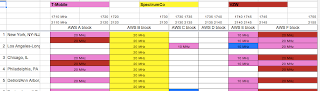
Of course, all of the above is contingent upon FCC approval of the VZW-SpectrumCo-Cox and VZW-T-Mobile transactions, as well as two smaller spectrum swaps involving VZW-Leap and T-Mobile-Leap.  Assuming that all get the go ahead, here is a look at VZW and T-Mobile AWS spectrum holdings, both pre and post transaction, in the top 25 markets (where VZW and T-Mobile combined would control 75 percent of all AWS spectrum):


-AJ

Sources:  T-Mobile USA, FCC, CNET